Pichai Pongsasaovapark's Portfolio
Delve into a selection of my paintings and photography included in various exhibitions and art fairs around the world. Many of my abstract paintings were created using unconventional tools, adding unique textures and expressions, and represent a journey of creative exploration to art-making.
My conceptual art and installation pieces are the result of immersive research, conducting interviews, and spending time in the field to truly understand my subjects. All have a message and story behind them.
Selected Exhibitions

Exhibition poster image courtesy of VS Gallery; installation photos by Vinai Dithajohn
Beyond Loss (2026)
When Pichai heard that 48 commercial fishing boats in Pattani province had been destroyed to comply with the Government's policy of decommissioning unlicensed fishing boats, he decided to investigate. He discovered that fishermen, left with only the lumber of their boats, were forced to buy back the fragments to use as firewood to boil anchovies in the process of making budu fish sauce, a traditional local food product of Southern Thailand. When he went to interview the fishermen and visited where the boats were being dismantled, he was deeply moved by the piles of broken wood. He left with many questions about the fairness of what had taken place.
In this exhibition, Pichai translated the memories of that day by painting the scenes of destruction he had seen on the walls of the gallery space. In front of the paintings, he hung trawl nets, cut into thin strips and coated with ash produced from the burning of the dismantled fishing boat lumber. The use of such nets involves dragging them across the seabed, and while this can result in large catches of fish, such nets are now legally banned, as they sweep up everything in their path, causing the indiscriminate destruction of coral reefs, and endanger sea turtles and marine ecosystems. Bottom trawling also contributes to carbon dioxide emissions, as ocean sediments are among the world’s largest carbon sinks, and disturbing the seabed releases stored carbon back into the atmosphere.
This series of paintings and installation piece explore a dialogue between destruction and preservation: the dismantling of fishing boats built from Ta-Khian trees, where the construction of a single boat requires between 20 to 30 trees, and the protection of marine resources through the prohibition of bottom trawling.
Finally, the installation piece composed from fragments of destroyed fishing boats, topped by a recreation of a Ta-Khian tree emerging from the ruins, symbolizes the hope of life struggling to survive amid destruction, much like those fishermen, who have not given up hope to be able to continue their way of life.


Exhibitions for Abstract and Minimal Art (2026)
Organized and hosted in a virtual environment by the SikoraArts Gallery and Kuntz Matrix, the Inaugural Exhibition for Abstract and Minimalism 2026 (January 1-February 21, 2026), and Exhibition for Abstract and Minimal Art III 2026 (May 1-June 23, 2026), are celebrations of creative clarity, bold experimentation, and the global language of reduction and form, that combined brought together more than 200 works by over 100 artists from across the world, each contributing a distinct voice to the evolving conversation around abstraction and minimalism. Pichai contributed one work to each exhibition, including A Disproportionate Burden #13 (2020) (above top right), and Why Did You Go Away Diptych? (2021) (above bottom right).

Net Loss (2024)
In his exhibition, Net Loss, Pichai addresses issues of personal loss, economic loss, and the loss of the environment through the eyes, words, and experiences of local fishing communities i Pattani province in the south of Thailand. Believing that only those who share a common bond can feel free to express their feelings of loss, regret, guilt, and despair with each other, something increasingly lost in a society of social media strangers at a distance, the works visualize the many personal tragedies that ensued when the Thai Government destroyed unlicensed fishing vessels to comply with international demands.
The works include Pichai paying respect to the tree spirit, Nang Ta-khian; replicas of two of the destroyed vessels made of their melted down nail shavings; 48 bottles of budu sauce representing the destroyed fishing vessels, the lumber of which was often used as firewood to boil the anchovies that make the sauce; two hyper-realistic paintings of bottles of budu sauce, and a rhinestone-encrusted traditional toy spinning top (luk khang), evoking the constant state of policy changes by the government.

A Disproportionate Burden (2021)
In A Disproportionate Burden, Pichai steamrolled the beautiful and healthy produce grown by farmers for our benefit to give form on canvas to the dangers of the chemicals used in modern agricultural production. Pichai’s work also captures the pressures that farmers feel to increase agricultural production and be able to compete in a global market.
The use of steamrolling as a form of printing evokes the use of steamrollers by law enforcement agencies to destroy illegal and counterfeit goods, publicly demonstrating a resolve to protect imported foreign intellectual property products.
Additional works in this series utilize newspapers, another printing approach, through which Pichai highlights the stock pages of the newspaper to reflect how the economy drives the overuse of dangerous agrichemicals.

RAMPANT (2020)
An incessant boxing ring bell commences a boxing match. It is the fight for their lives, their dignity, and their peace. They fight each other without bounds. The cheering crowd drowns out the discreet opening of a Pandora’s box. Fatal and colorless haze was rampant in the crowd, without regard to class, occupation, gender, or religion. It is a disaster for all people in the country; a real fight for survival. Everyone’s way of life is affected, waking in the morning paranoid. Life and death seem to be closer in every breath. When and how will this disaster end?
RAMPANT was a dual exhibition by contemporary and abstract artists, Pichai Pongsasaovapark and Sudaporn Teja, depicting their struggles during the COVID-19 pandemic in Thailand, with both confronting life and death, overcoming fear, time constraints, the disruption of what was normal, and the altering of one perspective on life and death.
Pichai's work explored a near-death experience, sickness from colon disease, and survival during the state of emergency, all of which led him to question his past actions, time lost, and the value of his remaining time on Earth. Influenced by the interrelation between the pandemic situation, rules, and time, he created mixed-media abstract art and installation art, challenging viewers to experience, interpret, and reappraise the past.

The Abstract Eye (2019)
Some people see the world as it appears – whole, complete, and unified. Others see the abstract qualities of the things around them -- the lines, the angles, the shades and shapes. Abstract artists see the ingredients, components, the subtle aspects and nuances of a thing, focusing on, and looking for, the intriguing regions and dimensions of our surroundings. They see things differently and with an eye for the abstract.
In this exhibition, The Abstract Eye, Pichai captures the angles and shadows, colors, hues, and textures that he saw in things, that others may not recognize or appreciate. Using photography as a tool, he has gone on an expedition, searching for things that are hidden in plain sight, revealing features of our environment and an entire world waiting to be seen by an astute observer. Like an explorer discovering new facets to a previously unknown landscape, the artist has revealed what he really sees, recognizing that beauty is truly in the eye of the beholder.

The Mess We Make (2019)
Pichai created this series, The Mess We Make, to refer to the utter lawlessness, mismanagement, and disinformation around the issue of air pollution. The works were inspired from the toxic smog that periodically blankets Thailand with the air-borne particulate PM2.5. Because of a lack of systematic and urgent air pollution management, the problem has risen steadily, leading to a serious health risk and danger to the public.
Pichai felt that it was the responsibility of artists to do something to make people notice this issue and how dangerous it is, since some people have no idea as to even when and why they should wear protective face masks, or even what types of masks they should use to prevent harm to their lungs from breathing such air pollution. In his view, while artists cannot solve the problems society faces in grappling with air pollution, it is important to always try to bring greater attention to these issues and the possible ways to deal with them.
Abstract Tradition (2019)
Being of Chinese ancestry and an admirer of traditional Chinese ink drawings and paintings, I created this series, Abstract Tradition, to honor my cultural heritage, yet do so with my sense of modern abstract form.
The result is a series of paintings, done solely in Chinese black ink, that express a more contemporary sensibility, yet, in my mind, are a direct link to a long tradition of such Chinese work.

Looking and Seeing (2017)
The Looking and Seeing exhibition, consisting of three separate series of works, visualizes the impact on human beings from global climate change, and addressing issues such as flooding, drought, and air pollution, through photography and the processes of simulating urban flooding and capturing exhaust emissions from motorized vehicles.
In the Deluge series, Pichai simulated the impact of extensive flooding, as a result of rising sea levels, on urban environments by soaking canvasses in tanks of water, mixed with pollutants, such as motor oil, clay, sludge, foodstuffs and beverages, household detergents, chemical products, plastics, and biological contaminants. The canvasses were then dried, painted, and placed in vats filled with water and clay, glue, synthetic plastic wrappings, botanicals, and acrylic paints to approximate conditions when urban areas are inundated. Finally removing, drying, and repainting with motor oil, the results are tapestry-like works reflecting the unsettling beauty from the flotsam and jetsam of urban floods.
In the Drought series, he overlaid photographs of drought-stricken rice farms and arid landscapes taken in northeast Thailand with portraits of the farmers most directly impacted by the unforgiving weather, capturing both their resignation and the heartbreaking sadness of their fading away with their arid land, their faces expressing a stoic acceptance of the harsh reality befallen them.
In The Air We Breathe series, he created stunningly beautiful images, seeming at first look as fields of flowers, by capturing exhaust emissions from such motorized vehicles as motorcycles, automobiles, vans, trucks, tillers, and rice combines. However, when one realizes that what is on the canvas is actually the physical manifestation of something dangerous to our health and a contributor to global climate change, the impact is immediate in creating awareness of the threat caused by air pollution.
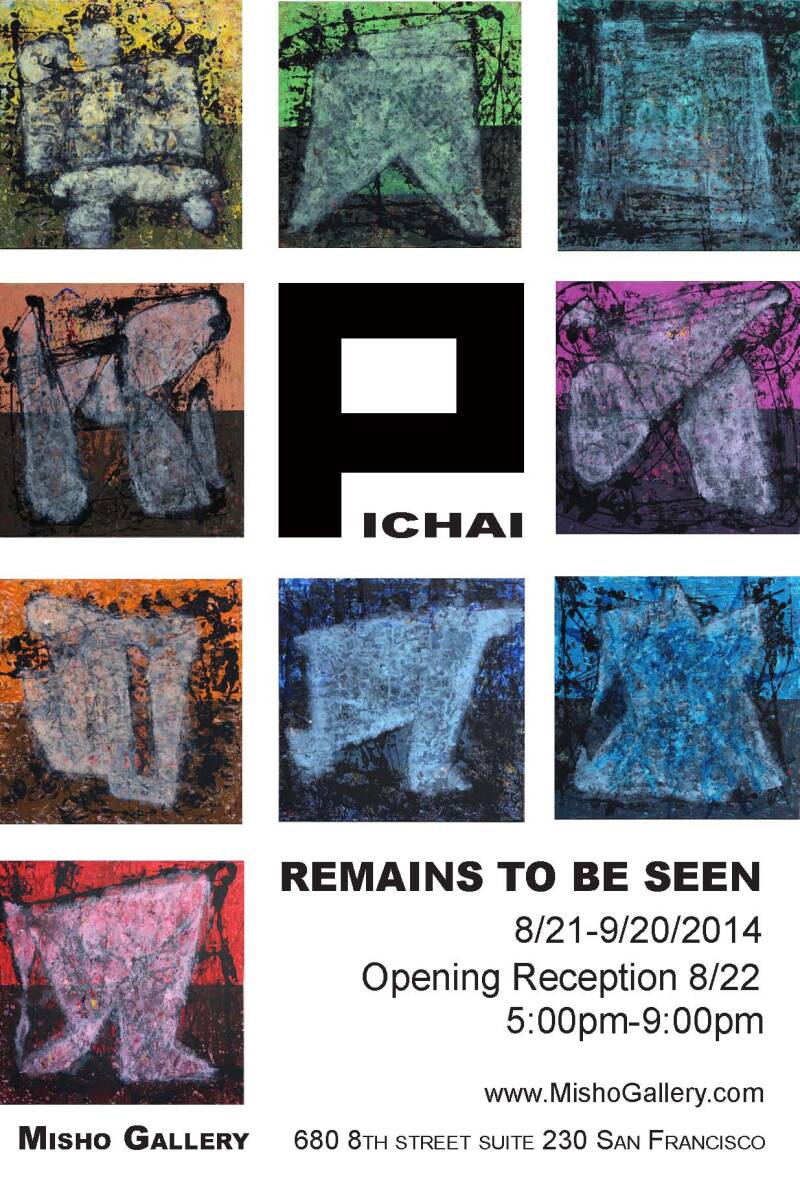
Remains to be See (2014)
Art is what remains when everything else is removed, what the eye refuses to look past, to ignore, to ameliorate. In the residue of life, of labor, in the fading penumbras of receding dreams, it hovers, hiding in plain view, waiting for us to see it for what it is, to decode, to understand. It is the shards of disaster, interpreted and translated by the lucky and unlucky alike, but never able to be understood or fully restored. It is the residue of urban floods, the ashes of burnt offerings, the smoky wisps and dying embers that beckon us, whimpering in pain and humiliation, with desperation and resignation. It is the siren call of flotsam and jetsam, forcing us against the railings, challenging our forgetting, preventing our moving on, compelling and pleading to not turn away, to drift off, to reorder our world.
It is the remains of a life, when one looks closely. The outline of what was, stubbornly refusing to depart, to disappear, to fade from view. It is a blade of grass, a dried leaf, a broken twig, invoking our memories of a forest. It is what remains when you close your eyes tightly, afraid to be excited, afraid to be reminded that you had forgotten something unforgettable, indescribable, indelible.
It tugs at our unconscious, slipping in through the cracks, haunting us, enticing us, playing with us, pricking us to see what we may not wish to see. It imagines what was, what could have been, and what will never be again. Like archeologists of the soul, turning rocks, sifting bones, seeing what is still with us, still a part of us, and though buried, that which still remains when we thought it could never be seen again. When all is gone, but not gone, it is art that remains to be seen.
Lines (2014)

Fast Start, Slow Burn (2013)

Altered Terrains (2013)

Night Beckons (2012)

Unseen Dimensions (2012)

Art in Nature in Art (2012)

Exhibition poster photo and exhibition photos by Preecha Pattara
Selected Photography Series
Buddhist Daily (2026)
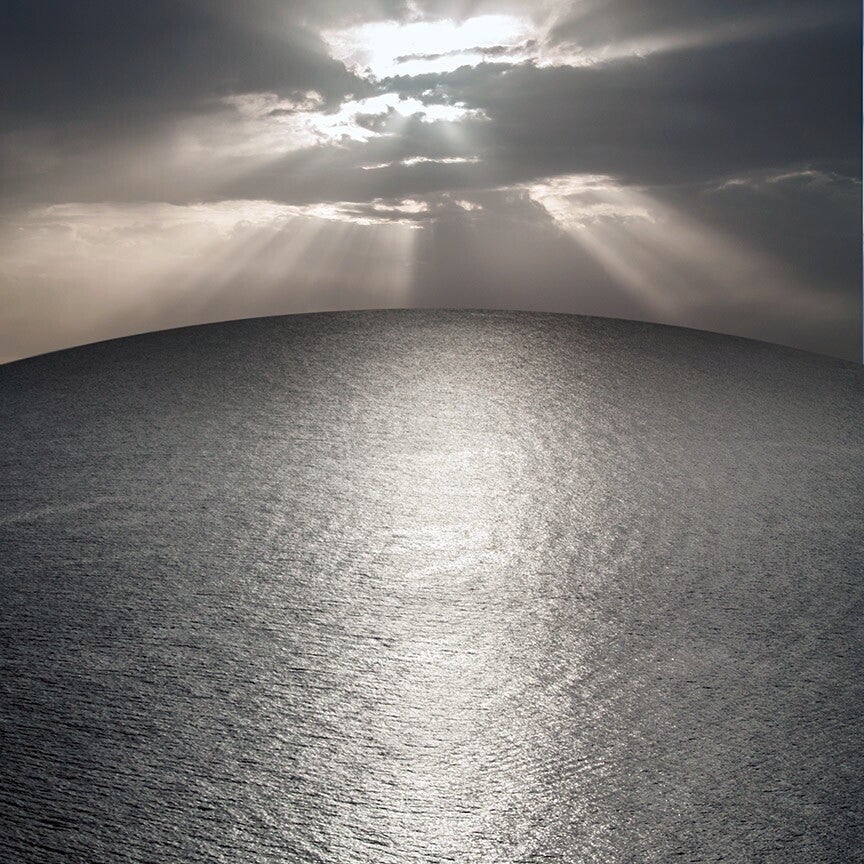
Using different photo software tools, these are some of my experiments in digital photography from over the years and in different places.
From landscapes and buildings to close up studies of everyday objects, I am always looking for the details in what I see around me every day.
Form Follows Function (2020)
Form follows function is a principle associated with late 19th/early 20th Century architecture and design, and means the shape of a building or object should relate to its intended function or purpose. In this series, I took digital photographs of the artwork stand that I designed for my very first art exhibition, Art in Nature in Art.
The function of this artwork stand was a necessity since I was exhibiting in a space in which I could not use the walls, leaving me with no option but to design a way to exhibit my artwork.
After I took those photograph in black and white and at different angles, the shade and shadow of the artwork stand was striking. Using software to alter the colors to negative, I manipulated some of the photographs to achieve both a bolder color and an intriguing shape.
The resulting colors and angles became their own abstract art.
Under Strain (2018)
Given the pervasive nature and impact of social media today, individuals are being inundated by information and opinions, and bombarded by constant news of natural disasters, tragedies, environmental catastrophes, economic trends, social upheaval, political turmoil, or destructive and violent human tendencies. Everyone is being forced to absorb a torrent of online comments, opinions, criticism, and bad news, resulting in global stress. The works function as a type of artistic “primal scream,” allowing a venting of emotions, frustrations, and catharsis, resulting in a calmer state of mind, if only temporary in nature. It allowed the act of creating art to be therapeutic by digitally "scratching" the photos as a way to relieve stress and make a statement against things in society that cause it.
Man and Tree (2015)
While Man and Nature had long co-existed in a balance and natural harmony, in recent times, Man has upset that balance by over-exploiting natural resources and destroying the environment for economic and survival motivations. This is all too vividly demonstrated by the global scope of deforestation.
Pichai tackled this issue by personalizing it. He overlaid his shadow with a tree’s shadow, attempting to humanize the issue and gain an understanding and empathy of the tree's point of view in the tense co-existence with Man.

Identity/Memory (2015)
In exploring one's identity, one looks to one's memories, but memories can be tricky things. Sometimes they are dreamlike and disturbing, or they seem real and unreal at the same time.
In Identity/Memory, created for an exhibition in London, Pichai selected three photographs that recalled distinct memories for him: a footprint in the sand, a carving on a tree, and a stag's head discarded and facing a corner. Each evoked a precise moment in time and are unique slivers of his memory.


Reading Between the Lines (2014)
Print media captures our lives, reflecting our interests and the issues of public concern. Newspapers, while competing with online media, are still a reminder of "the news" in words and images, and form an historical record of cultures. In Reading Between the Lines, created for an exhibition that Pichai curated of works by American artists living in Thailand and Thai artists who had lived in the United States, he used the front cover pages of American and Thai newspapers published on the same day during one month.
Digitally merging and assembling them as a single work resulted in a snapshot of both cultures, evoking the national colors of Thailand and the United States.
Messages (2014-2025)
Over the years, drawing on his background in graphic and industrial design, Pichai has created images for different messaging and promotional campaigns dealing with anti-Asian violence, peace and freedom, the environment, and other social issues.
He has also done various commercial series for artist cooperatives, non-profit organizations, and events, most of them donated or licensed for fundraising.
Selected Installations
Pichai has created a number of conceptual installations to convey a message about certain environmental and social issues.
Whether driving a steamroller to crush pesticide-contaminated botanicals on canvas, erecting geometric structures in a rice paddy to symbolize the threat to agricultural land and livelihoods from land conversion and unrestrained urbanization, visualizing the pain of loss by Thai fishermen from the destruction of their fishing vessels, or saving humanity's cultural legacy by taking it to space, his projects and resulting art are creative visions that make a point and send a message.
Photos courtesy of Chiang Mai Art for Air

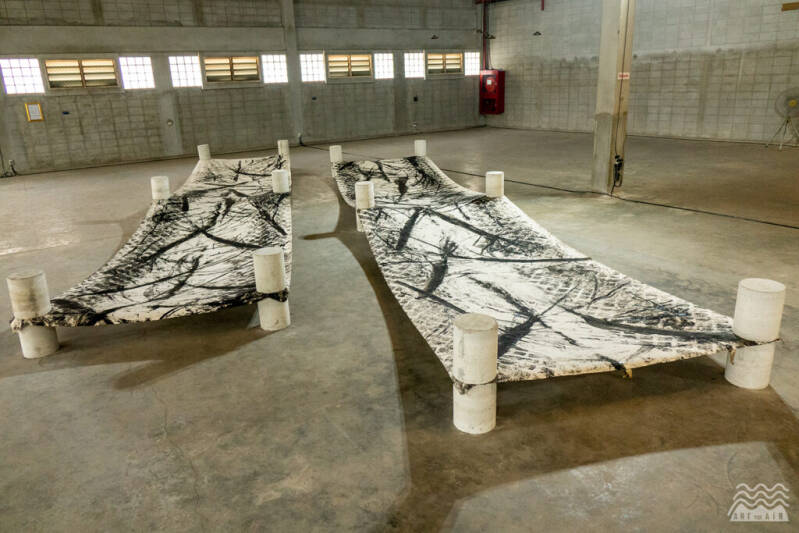
Beyond Loss II (2026)
From the beginning of my field research into the lives of fishing communities along the Pattani River, I have now returned to where the journey first began. This time, for the Pattani Biennale 2026, at Sapakafe 36, an exhibition venue situated on the banks of the Pattani River. The work presented is an installation titled Beyond Loss II that explores a dialogue between sustainability and the destruction of livelihoods through the life cycle of 48 fishing boats from Pattani Province. It reflects upon memory, the traces of loss, and the enduring question of the future of communities whose lives have long been intertwined with the river and the sea.
Beyond Loss II also recalls a time before modern marine navigation, when Thai fishermen relied on centuries of accumulated knowledge to sail by observing the sun, moon, winds, waves, and ocean currents, read the seasons, and predict weather conditions. At night, they used the stars and constellations as celestial maps to determine direction. This knowledge was the foundation of Thai maritime culture, with starlight literally guiding fishermen across the sea, a connection reimagined with the floating budu bottles being directly connected to fish and the stars.
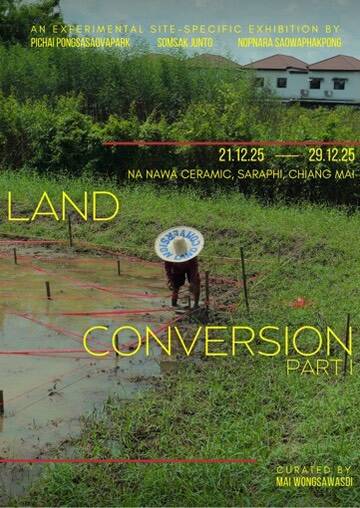
Land Conversion, Part 1 (2025)
In Land Conversion, Part 1, Pichai joined with fellow artists, Somsak Junto and Nopnara Saowaphakpong, to collaborate on a conceptual, site-specific project to explore the environmental, historical, and cultural transformation of the landscape. They sought to reclaim and transform a former rice field, in an attempt to revitalize the unused plot of land. Planting rice became a creative process.
For his part, Pichai created various structures, using reclaimed, recycled, and discarded construction materials, to represent encroachment of non-farm structures on land once devoted to farming. His mirrored laminated sculptures evoke the geometry and infrastructure of urban expansion encroaching upon rural landscapes. He consciously allowed for changing natural conditions, weather, and unpredictable forces to play a role in creating the ultimate look of the works, with the result that the shifting reflections appearing on the surfaces captured the surrounding environment at all times. The materials used, like cement, pigment powder, soil from other paddies, laminate, and wire mesh responded to humidity and the sun's heat, creating distortions, stains and cracks, which became not flaws, but integral to the work, and evidence of the pressure, transformation, and vulnerability that agricultural land endures.
Land Conversion, Part 1 does not merely ask what should be preserved or what has already been lost. It is a temporary ritual, calling forth the past before everything returns to its cycle once more.

Timeless Art Space Travel (2022)
As humanity faces global environmental destruction from rising seas, air pollution, and catastrophic climate change, Pichai created a work that captures the challenge to save our greatest shared legacy and treasure – the world’s art. While it will be impracticable to take with us to space all of the individual pieces of art in the thousands of museum collections around the world, Pichai envisions an ingenious solution: miniaturize the greatest art museums, many of which are works of striking architectural art and design in their own right, and pack them for travel.
Timeless Art Space Travel, was created for The New Ark Exhibition, to take museum art collections aboard the New Ark spaceship, which seemed a good solution, since travel and art are what humans have always being doing. Drawing on his experience in industrial architecture and model-making, he used recycled materials, second-hand vintage luggage and suitcases from China, Europe, Japan, Thailand, and the U.S., a decade of catalogs, brochures and maps from the scores of museums he has visited, and with a nod to Arthur C. Clarke’s iconic space messenger, Pichai created a work that answers the eternal human question when packing for travel, “Can we take it with us?”

Art for Air Series (2022)
The work Pichai created for the Art for Air Exhibition reflects on the issue of monoculture agriculture, a major contributor to the haze crisis and PM 2.5 pollution across Southeast Asia. The performance involves sugarcane, sourced from Northern Thailand, being pressed onto a canvas using a steamroller, driven by Pichai as part of the live performance of creating the works.
The act of compression playfully references the destruction of illegal confiscated goods within judicial procedures, annually conducted by Thai law enforcement officials for public consumption. At the same time, the crushing force of the machine serves as a metaphor for the pressure imposed on farmers under capitalist market structures — systems that leave them with little choice but to remain trapped within industrial agricultural practices.
More than simply addressing air pollution at its surface, the works confront the broader economic structures of industrial agriculture and the power of large corporations operating behind the PM 2.5 crisis, revealing the intertwined impacts of environmental destruction, labor exploitation, and quality of life experienced by countless people.


Exhibition poster image courtesy of AVA Garde Art; installation photos by Preecha Pattara
Ripples of Identity (2020)
The Ripples of Identity pieces, created by Pichai for the In Between Exhibition, embody a loss of identity caused by one's beliefs, social values, pressures and religion. All of these are things that can set us adrift, resembling the ripples that occur on the surface of water. Even our own light breathing causes ripples until we cannot see our true selves reflected.
Pichai used light-weight mirrors to create a texture that mimics the ripple motions of the water surface. The works were placed slightly above the water surface, contradicting the life journey on pursuing the true self even when every change in light and the ripples hitting the objects create new visuals, colors, and textures of the works. In his view, Pichai feels the installation illustrates and embodies the fragility, distortion, and depreciation that hide our true selves behind the mirror.
Documentary Films and Videos
Pichai has both created performance art videos and produced and directed short documentary films, dealing with topics such a air pollution, urbanization, and celebrating his mother's life as she reached 100 years of age.
48 Boats - a poem by Pichai Pongsasaovapark (2026).
A tribute to the 48 boats.
To the boat owners, who took on debts and loans to sustain their lives and their relationship with the sea.
To the skippers, who know the direction of the wind, the waves, the currents, and the seasons.
To the fishermen and boat workers, who trade their physical strength for every fish that reaches the shore.
To the boat builders, mechanics, and net repairers.
To the fishing net shops, ice factories, and fish vendors.
To the people who carry the fish, and the drivers who transport them.
To the smell of saltwater, the smoke rising from the harbor, and the lights glowing at night across the sea.
To the sound of engines, green oil, diesel fuel, B7 and B10.
To the families waiting for their loved ones to return to shore.
To the children who grew up with the sound of waves and the rhythms of the harbor.
To every life that once moved through the ecosystem of the fishing industry.
We offer this tribute not to glorify greatness,
but to remember that, once upon a time, countless people had lives, dignity, livelihoods, and hopes, all bound together by the same sea.
Even today, as many of these boats have been destroyed, their wooden remains burned, and their engines fallen silent,
the memories, labor, sweat, and lives of the people who depended on them should not disappear with the boats.
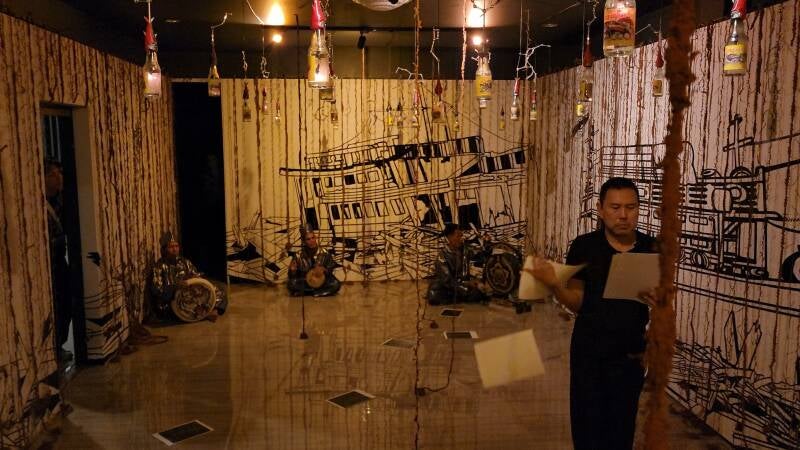
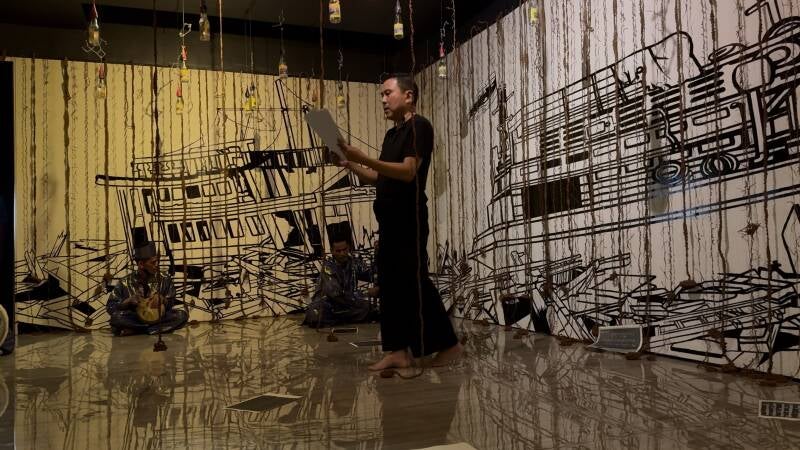
Performance by Pichai Pongsasaovapark, accompanied by Sritani, a local traditional Thai gong and percussion group.
Aor in Her Own Words: Living Through Five Reigns (2026)
Aor in Her Own Words: Living Through Five Reigns is a short documentary film by Pichai about his mother, Phaka Pongsasaovapark, known as Aor, who turned 100 years of age in 2026, looking back on her life under the reigns of five Thai monarchs.
Always charming and engaging, Aor recounts stories of her childhood, growing up in rural poverty in the south of Thailand, marrying young and struggling to raise her family of 11 children, but always seeing the promise of hope and a better day ahead, and never giving up her curiosity and love for life and creativity.


Poster image by Busaba Sansupha; graphic design by Peter N. Fowler.
Land Conversion (2026)
Land Conversion is a short documentary film about the site-specific art installation project created by Thai artists Pichai Pongsasaovapark, Somsak Junto, and Nopnara Saowaphakpong, to explore the issues of land conversion, transformation of land, rice cultivation, and the very meaning of farming.
The film captures the artistic and physical process of creating a rice paddy, viewing farming itself as a site-specific art form that brings natural heritage and history into a localized space, and the personal motivations by the artists in doing so.
Filmed in Chiang Mai, Thailand, the film covers in one rice-growing season the age-old processes of Hope (planting), Care (growth), and Harvesting (happiness), and prompts viewers to consider the intersections of agriculture, rapid urban expansion, spatial heritage, and farming as a disappearing cultural art form.
Completed in June 2026, to date it has screened in several film festivals, won two Best Short Documentary Awards, and the Bangkok Society of Film Critics Award for Best Short Documentary Film.





Steamroller Art (2022)
Invited to participate in Art for Air Exhibition in Chiang Mai, Thailand, held during the seasonal air pollution brought on by the burning of agricultural land by many Thai farmers, Pichai filmed his driving a steamroller to create art with sugarcane from Northern Thailand being pressed onto a canvas as part of the Opening Ceremony for the exhibition.
This act of creative destruction playfully references the destruction of illegal counterfeit goods conducted by Thai law enforcement officials for public consumption. The crushing force of the machine serves as a metaphor for the pressure imposed by global market systems that leave farmers with little choice but to remain trapped within global industrial agricultural practices.
The film not only addresses the air pollution caused by the burning of agricultural land, but the structures of industrial agriculture and the power of large corporations behind the air pollution crisis, revealing the intertwined impacts of exploitation and environmental destruction.
Film courtesy of Chiang Mai Art for Air (2022).


Looking and Seeing (2017)
To set the tone for his exhibition, Looking and Seeing, about the impact on human beings from global climate change, addressing issues such as flooding, drought and air pollution, Pichai created a video piece that captures the process of his creating the Poison Flower series.
He also collaborated with Thai photographer Preecha Pattara in creating a series of posters that were meant to send the message of pollution being all around us in our daily lives.
Film courtesy of SAC Gallery; poster images below by Preecha Pattara, graphic design by SAC Gallery.


Live Art Performance in Collaboration with Le Group Jazz Quartet (2015)

In October 2015, in conjunction with the Opening Night for the group exhibition, Making Senses: Living in an Abstract World, which he both curated and showed art in, Pichai did a live artwork performance with the Le Group Jazz Quartet, at the Misho Gallery, in San Francisco, California.
Video courtesy of Doris Chew.